Thursday, March 29, 2012

Racial Political Cartoons


I was Googleing pictures of Trayvon Martin, and I think it is ironic that this political cartoon appeared along with many others. I had to analyze the cartoon as it does fit to the current controversy on the Trayvon Martin Case.

The black lettering at the top left corner of the cartoon says "How A Racist Calculates". Now notice the white handwriting. To me, I automatically thought this was coming from an African American's point of view towards a white man. The white lettering is actually in the form of a formula that corresponds to the overall case. Trayvon Martin was the black kid, he was in a white neighborhood, and the result was that he got shot. Not only is the writing white, but also the outlining of the pictures are white that correspond to the "formula." When I look at that, I think innocence. Let's direct the attention to the focal point of the entire cartoon: the male who shot Tray. Most of the image is black which portrays darkness. His features are very distinctive and manly. He definitely fits the image of a "bad guy." His facial expression insinuates that he knowingly has a gun in his hand and is about to use it. The darkness all the way up to his actual facial features shows race. He appears white. The background colors are white and red that, when they meet, blend together eventually. I believe those colors were used to help put the cartoon together; bloodshed of an innocent child. To add to my credibility, if you have every seen the movie "Open Season", it is a comedy about two wild animals that convince each other to leave their homes and venture the real world. Corresponding to the incident, Tray wasn't in his original neighborhood, he was visiting a family member. He ventured out to the grocery store, and unfortunately experienced more than he should have--death.

I am not sure how this is affecting the rest of the public or anyone at Penn State, but it just goes to show that the government still does not do its job of serving justice. Additionally, it publicizes racism and events that should not be justifiable. I feel for Trayvon and his family, and I hope one day "we" can get things right.

Friday, March 23, 2012

Contextual vs. Textual Writing

I'm pretty sure everyone who thought they were a great writer established that assumption in High School, however; it's a whole different ball game when college starts. I was one of those people whose view drastically changed when reaching college. When I think of my writing process, I think of how easy creative ideas come my way but also how difficult the overall construction of the paper. I like sentence structure variation, but I know one of my weaknesses is writing in a round-a-bout way.

I always thought there was only one concept in writing a rhetorical analysis. But ofcourse I was wrong here too. There are two concepts to keep in mind when writing a rhetorical analysis: contextual and textual analyzing. Yes, they are totally different from eachother in a writer's world.

A textual analysis encompasses the actual material being analyzed. A textual analysis consists of some background knowledge on things such as the time period and societal issues. Analyzing the text with these elements creates the deeper meaning an analysis should have.

It is difficult because I feel there is a fine line between textual and contextual. I also think there is a fine line between analyzing something and flat out over thinking something. Maybe from a Professor's point of view, I want to know what are some pointers a student can use to make their analysis deep? Even though we incorporate quotes in a paper to support an idea or a concept, can those quotes be contextual? Why is a contextual analysis better than one that is textual? From a student's point of view, how did you do in writing your rhetorical analysis? If you did well, what tips could you give your peers? If you didn't do so great, what questions are still unanswered? Because I don't think the difference between contextual and textual is obvious. But obviously my grade proves otherwise.

Thursday, February 23, 2012

The Effectiveness of Rhetorical Appeals

I am sitting in my room writing my rhetorical analysis. Throughout the speech, analyzing, pathos, logos, and ethos are very clearly portrayed as effective rhetorical mechanisms to persuade the audience. What I wanted to know is which appeal is most effective when trying to draw the audience in and feel what the writer feels. In order to fairly assess the appeals, I decided to take a look at the JFK's Inaugural Address.

To immediately draw attention to him, he starts his speech off by calling, "Vice President Johnson, Mr. Speaker, Mr. Chief Justice, President Eisenhower, Vice President Nixon, President Truman..." instantly appealing to ethos. I think Kennedy did this to show his relationship with these people: all important and popular figures of the time. This is kind of a way to say hey I know these people, they have contributed something to our society and so will I. Beginning any speech by incorporating ethos is important because the audience wants credibility. We want other sources that back up the persuader/speaker.

Pathos throughout the speech is most evident. Phrases such as "To those old allies...", "To those new States...", "To those peoples in the huts and villages...", "To our sister republics outside of the border...", etc. all appeal to a broad audience which is a technique of pathos. Using these phrases draws in every viewer because he points out many different groups. He also uses "...my fellow citizens", ..."...in your hand more than mine..."...but let us begin...", and many more all give everyone who is tuning in a sense of community. And if communities can feel united by one speech, then they can feel united by the changes he will enforce as President. If you look at politicians' promises, almost all of them are broken. If he can persuade the public that he is in this fight with us, that appeals to the sense of not being alone which was very affective after the Great Depression.

Finally the appeal to logic. Always, logos is strictly statistics incorporated to quantitatively make a statement stronger. Sometimes it is put in a way to reinforce something or reassure an action. JFK says, "...All this will not be finished in the first 100 days. Nor will it be finished in the first 1,000 days, nor in the life of this Administration...." This is simply logic. We all know that one person cannot change everything the people are asking for in a matter of days, weeks, months or even years ESPECIALLY after the Great Depression.

In conclusion, all devices are quite effective. But I believe that in order to reach out and gain one's attention, pathos is the way to go. It always depends on the audience and what the subject is but almost always, the audience wants to feel a connection to the speaker. They want to feel they can trust them.

What Rhetorical appeal do you deem most effective and why?

Wednesday, February 15, 2012

"...I'm Lovin' It"


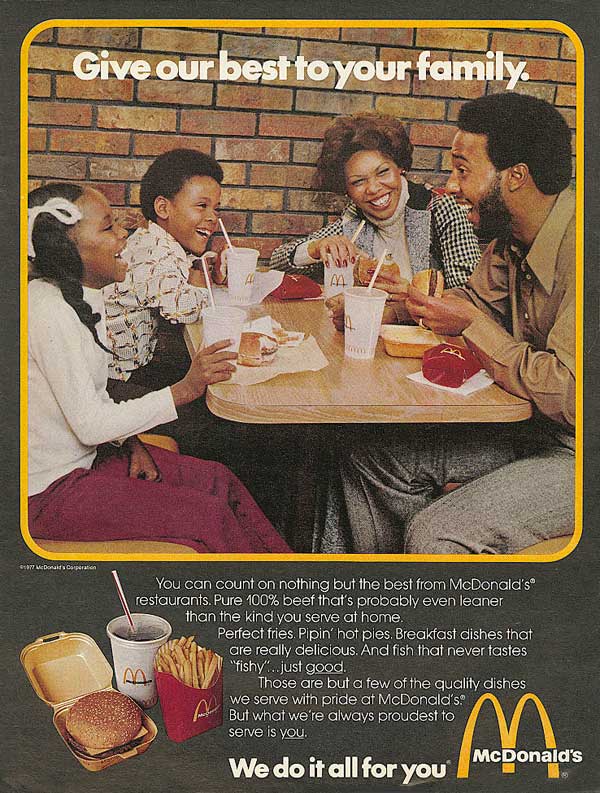
We have been learning about analyzing advertisements, directing our attention to the rhetoric appeals. We are learning to keep the audience in mind; and although we should feed off of what the ad shows us, we are learning to investigate what it does not. From the print to the colors down to the font size we consider the immense amount of detail, or lack of. I figure while we are rhetorically analyzing these ads in the classroom, why not practice some more.

This is a McDonald's ad as you can see. If you look at the colors of the clothing and even the lighting in the picture, you can infer that this is an old advertisement. Also, if you look closely, the father's pants start to open up wide in the end which you can also infer are bell bottoms that were worn in the 70's and 80's. They choose the yellow border because of the feel you get when looking at this ad, happy. But, the yellow is not just applied any way. It serves as a thick border around the picture which I feel emphasizes the good time they are having eating McDonald's. This particular McDonald's ad is appealing to both pathos and logos. Pathos because of the family smiling. You get the sense of togetherness from the "We do it all for you" and "Give our best to your family". Words such as "we" and "you" give a personal feel to any ad because it lets us know they keep customer's interests and feelings in mind.

You may or may not be able to see it but Logos is used in the fine print. It just talks about McDonald's and its pure 100% beef probably leaner than the kind you serve at home. This also can give you the feel that this is somewhat of an old ad because we all know today, the meet McDonald's uses is not the cleanest nor the healthiest, and certainly not leaner than the kind served at home. It further goes on to note McDonald's "perfect french fries and pipin' hot pies" which appeals more to the customer because of the use of alliteration and appealing adjectives.

Is there anything in this ad that you think they purposely left out and why?

Tuesday, February 7, 2012

Coloring Outside the Lines

I am sitting here reading chapter 7 in our "Rhetoric and Civic Life" book. I am reading about the arrangement and the careful strategies of planning a rhetorical analysis. I am reading that people do not just write papers, they format them incorporating the appropriate style, audience, invention, and rhetorical resources.
It's funny because I used to just freely write; thinking that I could be more effective, and appeal to those who like to "color outside the lines". Now, when I say "coloring outside the lines", I mean taking a chance to be free in hope that it might just make a masterpiece. Most artists' pictures are never clear, clean, or perfectly thought out; they are creative. I figure if I creatively piece experiences together and make it so that anyone could relate, I could create a masterpiece.


This is what famous artists consider fabulous, amazing, opaque, yet very intellectual. This is a famous oil painting from China. One could not really tell what it is, yet they can make it whatever they choose to see. I guess that is the purpose of some artists' artwork. They produce work in which anyone can relate to that do not have a direct message; hence making it what you choose to see.

But I guess this is not art. This is not poetry nor spoken word. I am no story-teller. I want to be an effective communicator and persuader. I want to be an interpreter. I want people to not only hear, but also listen.

Maybe I am crazy for comparing art to writing, but both are masterpieces. Now that I really think about it, both are planned, just planned differently with a different motive. Both have an audience. Comparable to speeches; there are five organizational components that will make a speech successful. I mean maybe artists have components that will draw in buyers and other artists. And maybe it seems like I am rambling or that I being totally contradicting; but really I am typing and at the same time learning: correcting my mistakes along the way but not erasing them. Whether in a paper or on a canvas, "coloring" outside the lines is simply beautiful.

Have you ever had a time in life when being spontaneous (coloring outside the lines) was more effective than being concrete and straight forward or vice versa?

Thursday, February 2, 2012

TIB Podcast

http://youtu.be/kVyg_5xbsnc

It's Just a flyer...RIGHT?

I am a part of an organization on campus called Black Student Union and I also serve as one of the executive members. Our purpose is to unify the black community at Penn State, educate Penn State's campus about black history and culture, and provide professional and career oriented resources/opportunities to ensure the success for African American students at Penn State. Although we are a new organization as of this year, we are well-known for the educational and professional programs on this campus. We are also known for our successful events as well as our professionalism on our executive board.

We are having a huge party of the year--something different from the school crap. This is our flyer for our upcoming party. For some reason, a person from another African American organization started to complain about our flyer saying it is too provocative and unprofessional. Also that it sends a message contradictory to our org's purpose. I automatically figured "this girl is just trying to make something out of nothing". A lot of people like the flyer, PLUS I see no reason to change it because of one person's opinion. I figure, just don't go to the freakn party; it's just a flyer...right?! My Exec board and I spoke more about it on the text group we have. I thought everyone would agree, however; few thought that if it was her opinion than it could be someone else's and we do not want to give others the wrong message. They argued that even in a time of fun, we still need to keep our professionalism.

Still I think it is just a flyer and did not understand the controversy. The girl is only showing a little cleavage and don't females dress like this when they go out anyway; making our party more attractive and enticing. Now if this girl were not on it, I do not think the outcome of the party will be as significant as if it had the female on it. Now, I don't believe in degrading women. But, I do not think accepting this flyer says I do. I figure even if we do change it, people will still say, "yo did you see that flyer BSU had up...they took it down but it was inappropriate." People are going to talk whether you change or stay the same. Am I being blind just because I want a bigger turnout, or was that girl from the other Org getting somewhere? It's just a flyer...RIGHT?!